
S BN 978-974-8496-14-6
WL Order Code 21 720 US$18.00
Bangkok 1994, repr. from 1890; 152 pp., 32
pp. illus., 145 x 210 mm, pbk.
Anonymous,The French in Indo-China
At the time of its first publication in 1879, this was the first record in English
of the French penetration into Vietnam, Laos and Cambodia which led,
within a few years, to French colonization of the region.
Making extensive
use of first-hand accounts, the anonymous author provides the essence of
the major exploratory travels of the time.
Discussed are: Henri Mouhot’s
pioneering 1860 account of his ascent of the middle and upper Mekong;
Francis Garnier’s bold exploration of Cambodia, Laos, Tonkin and Yunnan
and Dr. A. Morice’s peregrinations among the little-known towns of French
Cochin-china.
No IS BN
WL Order Code 2 106
US$148.00
Ascona 1972, 154 pp., 28 pp. illus., 235 x
320 mm
Archaimbault, Charles;La Course de Pirogues au Laos:
Un Complexe
Culturel
Les courses de pirogues couvrent une aire géographique immense qui s’étend
de la Chine à l’Insulinde.
Au Laos, cette cérémonie présente des traits spécifiques
selon les sous‑cultures locales.
Sous ces différences qui relèvent de
facteurs historiques, l’auteur en se basant sur les textes, les croyances, les points
de départ et d’arrivée des pirogues lors des compétitions, décèle une fonction
commune: assurer au changement saisonnier la migration des génies ophidiens
qui sont liés à la fécondité des rizières.
Cette étude minutieuse qui débute par les courses de pirogues de Luong Prabang,
se poursuit par les compétitions
de Vientiane et se termine sur celles
de Basak, chefferie du Sud Laos dont l’auteur s’est appliqué à restituer tout
l’arrière‑plan religieux.
IS BN 978-974-8496-29-0
WL Order Code 21 751
US$21.00
Bangkok 1995, first English trans. from
1912; 144 pp., illus., 145 x 210 mm, pbk.
Bassenne, Marthe; In Laos and Siam
This diary describes the adventures and observations of a French woman during
a trip up the Mekong to Luang Prabang and back through Siam.
At the
end of 1909 the territorial situation in Indochina was largely consolidated and
Marthe Bassenne’s book provides a first glimpse of the extent of the French
efforts to open up the eagerly fought-over hinterland of Tonkin, Annam and
Cochin-china.
The Mekong and the Lao jungles were as wild and as deadly as
ever and this trip to experience the New Year festivities in Luang Prabang is
full of adventures with local people and wild nature.
On the way back, through
the northeastern Siamese provinces of Nongkhai, Uttaradit and Phitsanuloke
the feelings of the indigenous people towards a French woman, are faithfully
recorded.
For, while this book is factually correct in its details, it is so much the
richer for its emphasis on impressions and personal feelings of one of the rare
woman travelers in this part of the Far East.
The beautiful original photographs
of the first edition overwhelm the reader and immerse him in a wild world long
forgotten ... jungles and natural resources that are today, once again, ready to
be developed.
IS BN 978-2-85539-304-9
WL Order Code 21 933
US$28.00
Paris 1996, 285 pp., 180 x 260 mm
Bizot, F. & F. Lagirarde; La pureté par les mots «La pureté par les mots», ou Saddavimala, nous enseigne que la délivrance de
l’adepte passé par la connaissance des syllabes du pali.
La première partie du
texte résume le processus mystique qui permet à l’homme de changer du nature,
pour renaître dans le Dhamma.
La seconde expose les raisons de cette nécessité
du recours aux syllabes: il faut connaître l’alphabet et les règles de formation
des mots, parce que les notions phonétiques qui s’y rattachent sons liées aux
différents stades de la genèse du fidèle.
La prononciation correcte des «voyelles
brèves», des «voyelles longues», de la «nasale», des «syllabes sonores», des«syllabes sourdes», etc., engendre des production physiques et mentales pure,
qui font entrer le fidèle en possession d’un corps immortel—compose des organes
de la Doctrine—pour le conduire au ciel.
No IS BN
WL Order Code 8 403
US$18.00
Vientiane 2000, 176 pp., 140 pp. illus., 190
x 250 min, pbk.
Bouneung Yeunilavong : Traditional Lao Patterns
One of the few professionally done publications from Laos, this book displays
140 pages of drawings of Lao designs.
There are 56 lessons on the designs and
on how to draw them.
This book is of interest to artists and designers, especially
those interested in comparisons with Thai designs.
The book contains introductions
in Lao and English.
IS BN 978-974-8496-31-3
WL Order Code 21 765
US$33.00
Bangkok 1995, repr. from 1869; 417 pp., 27
pp. illus., 1 folded map, 150 x 215 mm, pbk.
Carné, Louis de;Travels on the Mekong: Cambodia, Laos, and Yunnan
This book is a report of the most famous expedition in Indochina, i.e., the
exploration of the Mekong as a trade route and as a route to build political
influence in Indochina.
This French official mission toiled under duress for
two years, losing its commander on the way, and accomplished, for the first
time, a systematic description of the great river and its surrounding peoples and
natural resources.
Louis de Carné was the representative of the French Minister
of Foreign Affairs and in charge of writing the trade and political report on
the findings of the Commission. The book does more than that as it takes up
the history of particular areas in some detail to place the French prospects for
gaining influence in perspective.
Illustrated with original sketches, many of
which were made by L. Delaporte, another member of the mission, this book is
essential reading for all those who seek to understand the background of today’s
geo-political changes and the new attempts to tap the rich sources of the river,
its tributary valleys, and its peoples.
IS BN 978-974-8434-86-5
WL Order Code 22 074
US$39.00
Bangkok 1999, 200 pp., illus., 70 pp. color
illus., 1 folded map in pocket, 210 x 290
mm, pbk.
Chazée, Laurant;The Peoples of Laos: Rural and Ethnic Diversities
This book is the first comprehensive study conducted in Laos combining
research on ethnic culture and indigenous values and the present socio-economic
development.
The 132 identified ethnic groups and sub-groups belong to
the four linguistic families represented in Laos: Tai, Austroasiatic, Miao-Yao,
and Sino-Tibetan.
For each linguistic family, a detailed case study shows the
ethno-linguistic specificity, as well as the institutional and socio-economic
complexity. 132 maps give the geographic distribution of each group in Laos,
while a large folded map shows the national linguistic and ethnic distribution
pattern.
For 56 ethnic groups and sub-groups, pictures cover people, habitat,
agro-ecosystems, production systems and ethnic-related activities and handicrafts.
This publication describes the peoples’ diversity in the rural areas of Laos
during the period 1992–1999. Specifically, the research, based on inter-disciplinary
and participatory approaches—historical, ethno-linguistic, institutional,
religious and natural resource management diversities of the rural communities—
was conducted for a better understanding of the values and organizations
of the rural communities.
In the current period of world globalization, with
the persistent challenge of poverty reduction through human development and
gender issues, this study highlights great people and rural mosaics, and the still
retained authenticity of Laos.
If this cultural richness is not understood and preserved,
several positive and environmentally friendly indigenous groups will
continue to lose ground, sometimes at great social and environmental cost.
This
work contributes to a better knowledge of the indigenous values and systems of
the ethnic groups, who are, or should be, the key partners and decision-makers
in conceiving and implementing socio-economic development programs.
IS BN 978-974-7534-61-0
WL Order Code 22 233
US$25.00
Bangkok 2001, 106 pp., 36 pp. color illus., 1
map, 210 x 290 mm, pbk.
Chazée, Laurent; The Mrabri in Laos: A World under the Canopy
This ethnological study presents the first published information on the Mrabri
living in Laos collected during two years of preservation, development, and
research activities.
There are currently less than 400 living Mrabri distributed
between northern Thailand and the Lao PDR. The Mrabri have been studied
in Thailand since 1919, but on the Lao side of the border no research was conducted
until 1999.
As of now there are only 28 Mrabri alive in the Lao PDR,
with 22 of them maintaining their nomadic way of life in the primary forest of
Sayabury Province.
For the Mrabri the most important values are freedom and
peace in the forest, and food availability.
In recent history, the main enemies
were human factors such as military events and misunderstandings, floods, illnesses,
accidents and tigers.
IS BN 978-974-8434-83-4
WL Order Code 22 189
US$32.00
Bangkok 2000, first English trans. of 1900;
458 pp., 40 pp. illus., 150 x 210 mm, pbk.
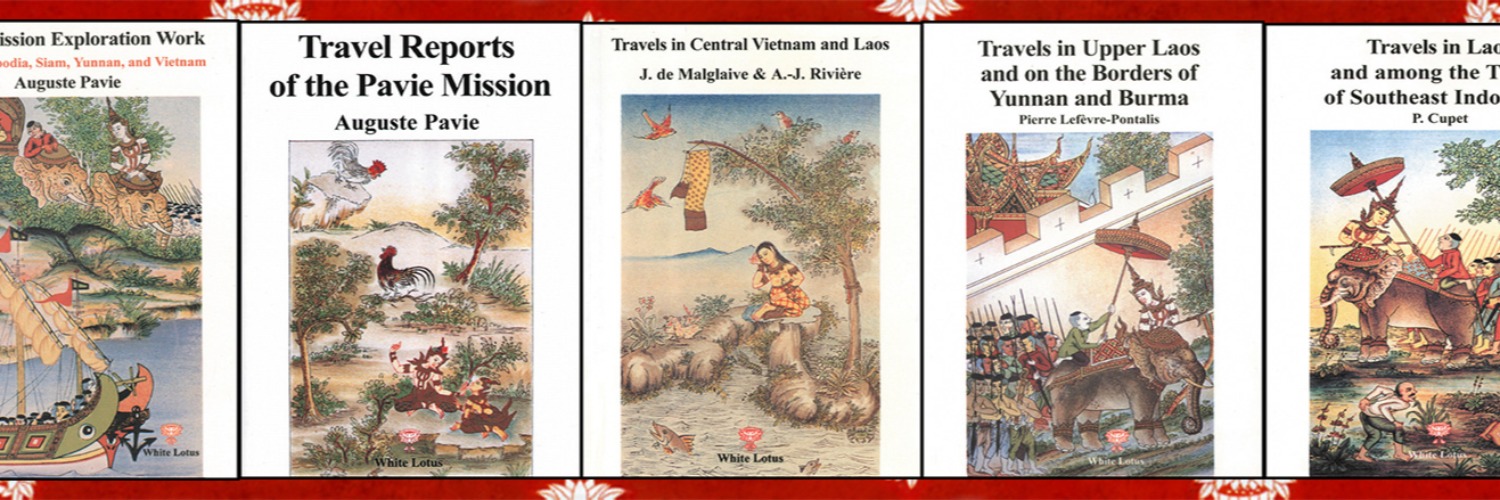
Cupet, P.; Travels in Laos and Among the Tribes of Southeast Indochina.
The Pavie Mission Indochina Papers (1879–1895), Vol. 6
This tome provides an overview of exploration work done in parts of Central Laos
and on the borders of Laos with Cambodia and Vietnam, parts of French Indochina.
The various itineraries in Laos cover the search for passages between the
Mekong and the Vietnamese coast, the country of the Puan people and territories
inhabited by tribes which were either under Vietnam’s or Siam’s sovereignty or
called themselves independent.
The book also documents lifestyles and customs
of various Moi, Bahnar, Djiarai, Sedang, and other primitive tribes.
Some of these
forgotten ethnic groups had already been visited by French Catholic missionaries
who contributed valuable ethnic data to the reports of the Pavie Mission.
The
explorations were often politically motivated and resulted in French occupation of
territories belonging to the primitive tribes of southern Laos and Vietnam.
IS BN 978-974-480-079-4
WL Order Code 21 865
US$55.00
Bangkok 1998, repr, 2006 in larger format;
225 pp., fully illus., partly in color, 255 x
350 mm, pbk.
Delaporte, Louis & Francis Garnier;A Pictorial Journey on the Old Mekong:
Cambodia, Laos and Yunnan. Vol. 3 of the Mekong Exploration Commission
Report (1866–1868)
In this third part of the Mekong Exploration Commission Report, 1866–1868,
published as an over sized volume with numerous splendid color plates and
four maps, the journey along the Mekong is retraced using plates not published
in the two other volumes on the Mekong Expedition as well as by masterfully
drawn color plates of tribal costumes from the regions the Commission passed
through.
This volume graphically supplements the descriptive reports of the
Commission’s work and can be read fruitfully in its own right as a journey
along the Old Mekong.
IS BN 978-974-480-000-8
WL Order Code 22 245
US$15.00
Bangkok 2001, 114 pp., illus., 150 x 210
mm, pbk.
Foo Check Teck,:Laos: “No Cola, Pepsi Only”
This is a light-hearted yet serious view of Laos through the eyes of a Singaporean
visiting Vientiane to impart the intricacies of finance to officials at theÉcole Nationale de Politique.
Cultural differences, teaching methods, culinary
delights and the École Nationale de Politique are part of the journey of discovery,
as are the smiling people—smiling despite their lack of affluence and
personal comforts to which Singaporeans are used.
IS BN 978-974-8495-84-2
WL Order Code 21 639
US$38.00
Bangkok 2001, repr. from 1993; 189 pp.,
fully illus. in color, 210 x 295 mm, pbk.
Igout, Michel ;Phnom Penh Then and Now
The most comprehensive book on the history of the capital of Cambodia. It
brings together 293 photographs, including numerous unpublished plates from
the period 1863 to 1931, and a large number of old maps and drawings unknown
until now.
A comparison of the serial views of Phnom Penh in 1931 and in
1993 reveals the astonishing transformation of the city, especially in the former
colonial quarter.
The author, a specialist on Cambodia, evokes the former
canals and bridges throughout the town, and the caiman hunts around the lake
where the Grand Market is situated today.
He defines the main stages in the
urbanization of the city, from its foundation in the fifteenth century and its
rebirth in the reign of King Norodom to the modern capital that developed after
independence and the changes following in the years from 1975 to 1993.
IS BN 078-074-8496-73-9
WL Order Code 21 863
US$33.00
Bangkok 1996, first English trans. from
1869–71; 370 pp., 43 black & white illus., 1
folded map, 140 x 210 mm, pbk.
Garnier, Francis; Travels in Cambodia and Part of Laos. Vol. 1 of the
Mekong Exploration Commission Report (1866–1868).
Travels in Cambodia and Part of Laos is the first part of the Mekong Exploration
Commission Report (1866–1868), one of the most important expeditions
sent to the Indo-China region to explore trade routes.
The French expedition
compiled a wealth of new information, drew maps, and produced a substantial
number of engravings of Laos.
It ended in Luang Prabang where the Commission
stayed some months.
While the original objective to ascertain that the
Mekong River could be used as a trade route between Yunnan and the Delta
was not achieved, the Commission’s political and socio-economic information
was invaluable for France’s expansion in Indochina.
A new map of Indochina as surveyed by the Commission is included in this book.
IS BN 078-074-8496-75-3
WL Order Code 21 864
US$32.00
Bangkok 1996, first English trans. from
1869–71; 301 pp., 30 black & white illus.,
150 x 210 mm, pbk.
Garnier, Francis; Further Travels in Laos and in Yunnan. Vol. 2 of the
Mekong Exploration Commission Report (1866–1868).
This second volume contains the report of the Commission’s travels in Upper
Laos and in Yunnan.
It ended with the return of the Commission via China and
reports on the dramatic Muslim uprising in Southern China.
Several attempts to
identify trade routes on the Mekong by the Commission’s most famous member,
Francis Garnier, are also included in the report.
IS BN 978-974-480-026-8
WL Order Code 22 314
US$23.00
Bangkok 2003, revised repr. from 1990; 322
pp., 150 x 210 mm, pbk.
Gunn, Geoffrey;Rebellion in Laos
The book examines two interconnected themes. First, the incorporation of
Laos into a colonial-capitalist system of surplus accumulation; and, second,
the rebellious and non-rebellious responses of the majority and, particularly,
the minority peasantry of that country to the fundamental changes in their
moral, social, political and economic order.
Both areas of exploration are
explained with reference to the general phenomenon of world-historical
expansion.
IS BN 978-974-480-063-3
WL Order Code 22 439
US$28.00
Bangkok 2005, 382 pp., 6 pp. illus., 3 maps,
150 x 210 mm, pbk.
Gunn, Geoffrey C.; Political Struggles in Laos (1930–1954)
This is the first detailed history of the origins of communism, ethno‑nationalism
and nationalism in the former French colony.
Communism first took root in
Laos under Vietnamese auspices in 1930, the year Ho Chi Minh’s Indochinese
Communist Party was founded.
Anti‑French nationalism under the Lao Issara
banner subsequently emerged in the shadow of war and was greatly stimulated
by the eclipse of French by Japanese power. As the French staged their bloody
post‑war restoration, the two tendencies in the anti‑colonial struggle found
common cause.
But shunned by the international community in exile in the
Thailand of Pridi Phanomyong, the Lao Issara withered.
While seeking a guerilla
rear‑base in Vietnam, the Pathet Lao tendency found willing sponsorship
from the Viet Minh in a trans‑national relationship.
At home the Pathet Lao
went from strength to strength drawing upon age‑old grievances of the minorities
in the highlands.
But it was not until the Geneva Conference on Indochina
in 1954 that the Pathet Lao gained recognition in the Kingdom of Laos as
legitimate actors in the nation’s political processes.
In a preliminary chapter the
author sketches the country’s pre‑colonial and early colonial history while the
political, military and diplomatic context surrounding the Pathet Lao triumph
in 1975 is outlined in a concluding section.
IS BN 978-974-8434-39-1
WL Order Code 22 018
US$28.00
Bangkok 1998, 290 pp., 150 x 210 mm,
pbk.
Gunn, Geoffrey C.; Theravadins, Colonialists and Commissars in Laos
This overview ranges across the history, sociology, politics and economy of this
small landlocked kingdom turned People’s Republic.
Theravadins stand for the
majority Lao Loum Buddhist population. Commissars stand for the soldierbureaucrats
who struggled to rebuild Laos in a communist mould.
Colonialists
stand as a metaphor for the French, and their American successors, who supported
the kingdom in the long civil war against Cold War adversaries. Once
a synonym for war and revolution, Laos today is a nation struggling to take its
place in the prosperity of the ASEAN economies.
However, the question of how
the communist Pathet Lao movement triumphed against all adversity, remains
unanswered. After the victory, the question arises of how successful the first
generations of communist rulers have been in managing this country, even by
their own standards? This book weaves together a number of threads in the
endeavor to answer these and other questions.
The book is divided in five parts:
Facts and Theory; anti-Colonial Stirrings; Civil War; Men who Make History;
State, Nation and Army and Problems of Development. An overview of recent
research and suggestions for the way forward concludes the book.
While the
book forms a unity, the essays stand alone and may be read as parallel histories
in their own right.
IS BN 978-974-8496-99-3
WL Order Code 21 952
US$27.00
Bangkok 1997, first English trans. from
1878–9; 292 pp., illus., 150 x 210 mm, pbk.
Harmand, F. J.; Laos and the Hilltribes of Indochina:
Journeys to the
Boloven Plateau, from Bassac to Hue Through Laos, and to the Origins
of the Thai
A report of explorations undertaken in Laos and present-day Vietnam by one of
the main architects of French expansion in Southeast Asia.
For the first part of
his explorations, Dr. Francois Jules Harmand concentrated his journey of early
1877 on exploring the Boloven Plateau.
His attention was focused especially
on natural history and on the tribes living in this area.
The second part of his
exploration brought him to river valleys in Central Laos and the country of the
Pou Thay, the original stock of the Thais, with the objective of finding a route
from Bassac on the Mekong to Hué on the Vietnamese coast.
The value of
his observations on nature, people and political relations is only surpassed by
the intrinsic value of this account as an example of nineteenth century French
colonialists at work.
IS BN 978-974-7534-85-6
WL Order Code 22 241
US$28.00
Bangkok 2001, 388 pp., illus., 150 x 210
mm, pbk.
Izikowitz, Karl Gustav; Lamet Hill Peasants in French Indochina
This classic account of fieldwork was written by a famous anthropologist in the
late 1930s. Izikowitz studied this remote Mon-Khmer group living in northern
Laos.
The account of most aspects of this society and culture is outstanding in
this comprehensive documentation of the Lamet’s relationship with their environment,
shifting cultivation and its ritual aspects, and the use of wild forest
produce.
The monograph includes a discussion on kinship, which in the words
of Rodney Needham was Karl Gustav Izikowitz’s “singular contribution to the
comparative study of alliance and classification.”
IS BN 978-974-480-044-2
WL Order Code 22 423
US$28.00
Bangkok 2004, 322 pp., 72 pp. illus., 2 maps,
150 x 210 mm, pbk.
Izikowitz, Karl Gustave; Over the Misty Mountain:
A Journey from Tonkin
to the Lamet in Laos
This work was first published in 1944 in Swedish and never before translated
into English.
Unfortunately, it has therefore remained an unknown work in most
scholarly circles.
This book preceded Izikowitz classic ethnographic work on
the Lamet, a Mon‑Khmer speaking people in Laos.
Izikowitz, a keen observer,
traveled in the late 1930s and studied the various tribal groups on his way to
the Lamet and back.
He recorded their customs, belief systems, ceremonies,
relationships as well as their agriculture, which is partly based on slash and
burn cultivation.
This more general work is rich in details, for example on the
French administrative system in those remote areas.
The work is enriched by
138 period photographs.
No IS BN
WL Order Code 21 617
US$60.00
Bangkok 1992, 1, 238 pp., 155 x 210 mm
Kerr, Allen D.; Lao-English Dictionary
Originally published in 1972 by the Catholic University of America Press in
two volumes. This is the second printing in one volume.
IS BN 978-974-8496-38-2
WL Order Code 21 809
US$28.00 Bangkok 1995, first English trans. from
1898; 229 pp., 130 x 200 mm, pbk.
Lefèvre, Émile;Travels in Laos:
The Fate of the Sip Song Pana and Muong
Sing (1894–1896)
Written by a member of the famous Pavie Mission, this book describes a dramatic
episode in the tale of French conquests in Indochina.
The rivalry of British
imperialism and French colonial activists, mostly operating from their Indochinese
base in Saigon, reached its culmination when the Asian possessions of
the superpowers met in Upper Laos.
Several small states that had been able to
preserve their relative independence by paying tribute to virtually all regional
powers, were finally caught up in the endgame of colonial expansion.
France was
to be the victor this time and formerly neutral states such as Muong Sing, the Hua
Pan Tang Ha Tang Hoc, the Sip Song Chu Tai and the Sip Song Pana, with their
semi-independent rulers, were to disappear to become present-day Laos and part
of Vietnam.
The story unfolds amidst the wild landscapes and fertile valleys of
Upper Laos where, for centuries, different peoples, all with their particular customs,
dress and languages, had fought each other for control of the land and the
trade routes.
The mission and Dr. Lefèvre spared no effort to travel the country
back and forth until finally a Franco-British agreement settled the border and also
the fate of the peoples.
In many cases, Dr. Lefèvre was the first white man the
tribes ever saw and he, in turn, was the last man to see their authentic life styles.
IS BN 978-974-8434-79-7
WL Order Code 22 166
US$28.00
Bangkok 2000, first English trans. of 1902;
402 pp., 80 pp. illus., l50 x 2l0 mm, pbk.
Lefèvre-Pontalis, Pierre; Travels in Upper Laos and on the Borders of Yunnan
and Burma.
The Pavie Mission Indochina Papers (1879–1895)—Vol. 5.
The book provides an overview of exploration work done in the upper part of
Laos and on the borders of Laos and Vietnam, as parts of French Indochina,
and of British Burma and China.
The various itineraries in Upper Laos cover
western areas bordering the British, Chinese and Siamese possessions and constitute
a preparation for a definitive settlement with the governments of British
Burma and of Yunnan.
The maps produced by these professional topographers
comprise important areas along the Mekong not yet surveyed until then, the roads
towards Siam from Yunnan and Muong Sing and, in general, the Sip Song Pahn
Na dependencies of Siam.
The book also documents villages of various primitive
Kha tribes and mixtures of various races living in this area covered with the mule
trails of traders.
The explorations were often politically motivated and resulted in
the annexation of Muong Sing to French Indochina. Volume 2 of this series, Atlas
of the Pavie Mission, contains the maps accompanying these explorations.
IS BN 978-974-8434-78-0
WL Order Code 22 148
US$24.00
Bangkok 2000, first English trans. of 1902;
350 pp., 48 pp. illus., 150 x 210 mm, pbk.
Malglaive, J. de & A.-J. Rivière; Travels in Central Vietnam and Laos.
The
Pavie Mission Indochina Papers (1879–1895)—Vol. 4.
Written by two untiring French army explorers this volume provides an overview
of exploration work done in the Central parts of Laos and Vietnam.
The
various itineraries cover the area between Luang Prabang and Bassac on the
Mekong and Vinh and Hué on the Vietnamese coast.
The maps produced
by these professional topographers comprise important river valleys only
partially uncovered until then, the country of the Puan and the settlement
areas of various primitive so-called Kha tribes of the plateaus and mountains
covering the narrow strip of land between Siam (Thailand) and French
Indochina. The explorations were carried out in the framework of the Mission
Pavie and politically motivated.
The itineraries during this part of the work were in particular geared to finding convenient access roads from the
Mekong to the coast.
Together with a series of maps and itineraries published
in Volume 2 of the series, Atlas of the Pavie Mission, that guide the
reader through these still relatively remote areas, period photographs provide
images of tribes long gone and primitive virgin landscapes thoroughly
changed by development,
IS BN 978-974-8434-13-1
WL Order Code 22 003
US$20.00
Bangkok 1998, first English trans. from
1666 with an extensive introduction by Luigi Bressan; 153 pp., 150 x 210 mm, pbk.
Marini, G. F. de; A New and Interesting Description of the Lao Kingdom(1642–1648)
This account was written by the Italian Jesuit G. F. de Marini based on several
sources, the most important of which was his colleague G. M. Leria who
worked in Laos from 1642 to 1648.
It is one of the few very early accounts of
that kingdom available. Originally recorded in Italian and published in 1663,
the descriptive parts of the account were published in French in 1666.
They
appear here for the first time in English.
The account deals with the considerable
riches and power of the Lao kingdom during this period.
It provides
information, recorded through the eyes of a Jesuit, on the religion, customs,
livelihood and natural qualities of the Lao people and on the much talked about
splendor of the Court and religious ceremonies in Laos.
IS BN 978-974-480-035-0
WL Order Code 22 350
US$21.00
Bangkok 2003, 284 pp., 4 pp. illus., 155 x
220 mm, pbk.
Nakhonkham Bouphanouvong :, Sixteen Years in the Land of Death:
Revolution
and Reeducation on Laos
This is the account of the life of Nakhonkham Boupanouvong, a Lao man who
survived incarceration from 1975 to 1991 in the communist run reeducation
camps located in the province of Huaphan in northeastern Laos.
During that
time he suffered through hard labor, torture and near starvation along with
many other high-ranking Royal Lao government and army officials, many
of whom did not live to tell their own experience.
Prior to his imprisonment
Nakhonkham endured three decades of civil war in Laos.
He left the capital city
of Vientiane and his life as a student behind in 1945 to join the Nationalistic
Lao Issara movement where he worked as a soldier, propagandist and writer
through the 1950’s.
Nakhonkham later witnessed the Lao Issara’s transformation
in eastern Laos into a full-fledged communist revolution.
Not convinced by
the communist rhetoric, he left to join the Neutralist faction formed in the early
1960’s.
With the Neutralist’s demise not long after its formation, Nakhonkham
found it necessary to join the Royal Lao Government where he worked as an
editor for several publications and eventually became a high-ranking police
officer in Vientiane.
Having come full circle, by 1975 Nakhonkham found himself
on the losing side of the civil war and lived in Laos as a political prisoner
until emigrating to the United States in 1992
IS BN 978-974-8496-88-7
WL Order Code 21 951
US$28.00
Bangkok 1997, first English trans. from
1884; 158 pp., illus., 150 x 210 mm, pbk.
Neis, P.; Travels in Upper Laos and Siam. With an Account of the Chinese
Haw Invasion and Puan Resistance.
A report of an exploration undertaken in 1882 in Upper Laos and the border areas
between British Burma, China, Vietnam and Siam by Doctor Neis under the
auspices of the French Minister of Public Education. Searching for knowledge
about the local tribes and a commercially viable trade route from the Mekong
valley to Annam or Tonkin (present-day Vietnam), Doctor Neis met the Puan
people fleeing from armed Chinese Haw bandits who had destroyed the Puan
kingdom and threatened to invade large parts of the valleys that are the Laotian
tributaries to the Mekong.
Doctor Neis found himself in dire straits, fleeing in
turn from the approaching Haw and eventually returning to Luang Prabang. He
explored the Nam Ou valley in Central Laos and described the local customs.
From Luang Prabang, he undertook the exploration of the Siamese vassal states
in the present-day Golden Triangle, and, besides the flourishing opium trade,
also found the British traders doing well.
Descending through Chiang Rai and
Chiang Mai, he provided a prophetic picture of expanding British interests and
of the struggle between the local northern vassals and residents sent by the
Bangkok government of King Chulalongkorn.
IS BN 978-974-8434-72-8
WL Order Code 6 550
US$17.00
Bangkok 1999, repr. from 1993; 88 pp.,
illus., 165 x 245 mm, pbk.
Ovesen, Jan; Anthropological Reconnaissance in Central Laos
This report is the result of a short-term anthropological consultancy which formed
part of the feasibility study for the future construction of a dam and hydroelectric
power plant in a rather remote area of central Laos.
The author concludes that
in contrast to (anthropologists’ opinion of) so many other development projects,
the present project will have mainly beneficial effects on the local population.
In
one part of the project area the population pressure and consequent shortening
of fallow periods make the continuation of swidden farming progressively less
viable.
The other part of the area consists of a flat plain where paddy cultivation
dominates, and conditions for the further development of wet-rice agriculture
are good.
It is envisaged that the hydro-power project may directly or indirectly
induce many of the swidden agriculturalists to move into the plain and become
paddy farmers, which is both economically and ecologically preferable.
IS BN 978-974-8434-75-9
WL Order Code 22 073
US$43.00
Bangkok 1999, first English trans. from
1903; 206 pp., 35 pp. illus. in color, 81 pp.
maps, 210 x 290 mm, pbk.
Pavie, Auguste; Atlas of the Pavie Mission.
Vol. 2. of the Pavie Mission Indochina Papers (1879-1895)
This volume provides an overview of exploration work done in Cambodia, Siam,
Laos and Vietnam by means of maps produced by the explorers and numerous
itineraries of staff members of the mission.
The various French expeditions,
carried out by a score of prominent researchers under the name Mission Pavie,
not only compiled a wealth of new scientific and historical information and
details on natural history they also drew up accurate maps for areas where no
western mapping work had previously been undertaken—especially in disputed
border areas between Laos, Siam, Cambodia, Yunnan and Vietnam.
This atlas
also contains a number of color plates, masterpieces of the art of the time that
were incorporated in various research reports of the mission.
Short descriptions
place these in the context of the work of the Pavie Mission as documented in the
other volumes in this series.
However, this Atlas should be used together with
Volume 1 of the series: Auguste Pavie, Pavie Mission Exploration Work. Laos,
Cambodia, Siam, Yunnan & Vietnam.
IS BN 978-974-8434-76-6
WL Order Code 22 076
US$42.00
Bangkok 1999, first English trans. of 1901,
1906; 774 pp., 234 illus., 150 x 210 mm,
pbk.
Pavie, Auguste; Pavie Mission Exploration Work.
Vol. 1 of the Pavie Mission Indochina Papers (1879–1895).
Volume 1 is the first part of The Pavie Mission Indochina Papers (1879–1895),
written by Auguste Pavie himself and provides an overview of exploration work
done in Cambodia, Siam, Laos and Tonkin.
The various French expeditions,
carried out by a score of prominent researchers under the name Mission Pavie,
not only compiled a wealth of new scientific and historical information and
details of natural history and drew up maps—especially of disputed border
areas between Laos, Siam, Cambodia, Yunnan and Vietnam—they also produced
political results serving the pro-colonial faction in France.
This book
contains short descriptions of numerous journeys made in Cambodia, the Great
Tonle-Sap Lake district between Siam and Cambodia, the Mekong in Cambodia,
North Siam and its border areas with Laos, East Laos and its border areas
with Tonkin, present-day Vietnam, and the Laotian areas bordering the middle
part of Vietnam, then Annam.
Together with a series of maps and itineraries
published in Volume 2 of the series, Atlas of the Pavie Mission, that guide the
reader through these still relatively remote areas, period photographs create an
image of the adventurous world of nineteenth century Indochina.
IS BN 978-974-8434-82-7
WL Order Code 22 114
US$42.00
Bangkok 1999, first English trans. from
1911, 1919; 774 pp., 111 illus., 150 x 210
mm, pbk.
Pavie, Auguste; Travels Reports of the Pavie Mission.
Vol. 3 of the Pavie Mission Indochina Papers (1879–1895)
This volume includes Auguste Pavie’s reports on his work in Upper Laos to
the French Ministry of Foreign Affairs, his vivid account of the destruction of
Luang Prabang and parts of his diaries on the 1893 Paknam Gunboat Incident
which was the pretext the French needed to detach the Laotian territories from
Siam. An overview of exploration work and Pavie’s political dealings with the
Black Flag irregulars in respect to their submission and the turning over of
suzerainty to France is given.
The ultimate goal—making a link suitable for use
by traders between Hanoi and Luang-Prabang as well as other trade outlets on
the Mekong—is also documented. Reports on Laos cover the areas inhabited
by the Puan and various Thai, Meo, and Kha tribes as well as insights into the
politics of local warlords and functionaries appointed by the various suzerains
of these valleys which are today part of Burma, Laos, and Yunnan in southern
China. Volume 2 of this series, Atlas of the Pavie Mission, contains maps
accompanying these explorations and plates documenting the gunboat battle at
Paknam in 1893.
IS BN 978-974-480-032-9
WL Order Code 22 346
US$36.00
Bangkok 2003, 205 pp., 48 pp. illus. in col.
150 x 210 mm, pbk.
Schliesinger, Joachim; Ethnic Groups of Laos,
Vol. 1:
Introduction and
Overview
This tome contains reports of early French encounters with ethnic groups as
well as more recent studies by professional anthropologists and linguists.
The
development of national classifications of ethnic groups by the Lao government
is presented up to the latest census of 1995.
All major ethnic groups are listed
according to their languages.
Finally, a short introduction to the history of the
region as well as an overview of the environment, the agricultural economy,
customs and practices of the diverse ethnic composition is outlined.
Traditions
and customs are portrayed by 169 color illustrations.
IS BN 978-974-480-036-7
WL Order Code 22 347
US$36.00 Bangkok 2003, 312 pp., 64 pp. in col. 150 x
210 mm, pbk.
Schliesinger, Joachim; Ethnic Groups of Laos,
Vol. 2: Profile of Austro-Asiatic-
Speaking Peoples
This volume outlines the Mon‑Khmer‑speaking groups of Laos who belong
to the Austro‑Asiatic language family.
The author describes the history, costumes
and crafts, design of houses and villages, agricultural economy, society
and religious practices of each individual group.
The text is supported by 195
color illustrations.
IS BN 978-974-480-037-4
WL Order Code 22 348
US$36.00
Bangkok 2003, 387 pp., 64 pp. illus. in col.
2 pp. maps, 150 x 210 mm, pbk.
Schliesinger, Joachim; Ethnic Groups of Laos,
Vol. 3: Profile of Austro-Thai
Speaking Peoples
This volume represents each of the Tai‑speaking as well as the two
Miao‑Yao‑speaking and the single Austronesian‑speaking groups in Laos.
History,
costumes and crafts, design of houses and villages, agricultural economy,
society and religious practices of each individual group are described and 210
color illustrations are included.
IS BN 978-974-480-031-2
WL Order Code 22 349
US$36.00
Bangkok 2003, 324 pp., 32 pp. illus. in col.
1 map, 150 x 210 mm, pbk.
Schliesinger, Joachim; Ethnic Groups of Laos,
Vol. 4: Sino-Tibetan-Speaking
Peoples
This volume deals with each of the Tibeto‑Burma speaking as well as one
Sinitic‑speaking group.
The text is accompanied by 127 color pictures and an
ample bibliography is included.
IS BN 978-0-226-76287-6
WL Order Code 5 731
US$23.00
Chicago 2006, 232 pp., 150 x 228 mm, pbk.
Smalley, William A., Chia Koua Vang and Gnia Yee Yang; Mother of Writing: The Origin and Development of a Hmong Messianic Script
In February of 1971, in the Laotian village of Nam Chia, a forty-one year old
farmer named Shong Lue Yang was assassinated by government soldiers.
Shong
Lue claimed to have been descended of God and given the mission of delivering
the first true Hmong alphabet.
Many believed him to be the Hmong people’s
long-awaited messiah, and his thousands of followers knew him as “Mother
(Source) of Writing.”
This work provides a nontechnical linguistic analysis of the script and a
survey of its current use.
In addition, it gives an intriguing cultural account of
Shong Lue’s life.
The book traces the twenty-year-long struggle to disseminate
the script after Shong Lue’s death, first by handwriting, then by primitive movable
type, an abortive attempt to design a wooden typewriter, and finally by
modern word processing.
In a moving concluding chapter, Smalley discusses
his own complex feelings about his coauthors’ story.
IS BN 978-974-8434-33-9
WL Order Code 22 017
US$27.00
Bangkok 1998, 250 pp., 150 x 210 mm,
pbk.
Stuart-Fox, Martin; The Lao Kingdom of Lan-Xang: Rise and Decline
The book provides a narrative account of the great Lao kingdom that flourished
in the middle Mekong region between the fourteenth and eighteenth centuries.
After an introductory chapter on the prehistory of Laos and migration of the
Tai-Lao peoples, the foundation of a unified Lao kingdom is examined in the
context of contending powers in mainland Southeast Asia.
Among the events
described are the Vietnamese invasion of the fifteenth century and subsequent
consolidation of the Lao kingdom, the Burmese invasions of the following
century and the arrival in the early seventeenth century of the first Europeans
to visit the Lao capital of Viang Chan (Vientiane).
The author shows how the
inland Lao kingdom was disadvantaged with respect to coastal trading states
and how the unitary Lao kingdom broke into three contending principalities in
the early eighteenth century.
This opened the way for Siamese domination of
the Lao world.
The last Lao attempt to shake off Siamese hegemony by King
Anuvong of Viang Chan in the Lao-Siamese war of 1827–28 is examined in
some detail because of the significance of its impact on subsequent relations
between the independent states of Laos and Thailand.
The book ends with the
French annexation of Lao territories east of the Mekong in 1893.
IS BN 978-974-480-023-7
WL Order Code 21 815
US$28.00
Bangkok 1995, rev. repr. 2002; 437 pp., 150
x 210 mm, pbk.
Stuart-Fox, Martin;
Buddhist Kingdom, Marxist State—The Making of
Modern Laos.
Studies in Southeast Asian History No. 2.
This book examines the history and politics of modern Laos from its establishment
as a French colony in the late 19th century to the communist state
it is today.
While the first three chapters outline the struggle between France
and Thailand for control over the territory of the present Lao state, the period
of French administration, and the Kingdom of Laos from 1946 to 1975, the
focus primarily is on the Lao People’s Democratic Republic during the first
two decades of its existence.
Themes taken up include the leadership of the Lao
revolutionary movement, why the regime failed to carry through its policy of
agricultural co-operativization, and its close relationship with Vietnam.
Special
attention is given to the transition from Buddhist kingdom to Marxist state,
how the Lao communist hierarchy has attempted to legitimize its seizure and
exercise of power, and how the Buddhist monastic order was reduced to a pliant
instrument of the new regime.
Also assessed are the errors and achievements
of the Lao revolution, the politics of patronage in present-day Laos, and the
effectiveness of Lao foreign policy.
The last two chapters weigh up the role of
the ruling Lao People’s Revolutionary Party and look to the future of Laos in
the rapidly integrating region of mainland Southeast Asia.
IS BN 978-974-480-075-6
WL Order Code 22 467
US$28.00
Bangkok 2005 revised repr. From 1989; 350
pp., 8 pp. illus. in col. 3 pp., maps, 150 x 210
mm, pbk.
Tapp, Nicholas; Sovereignty and Rebellion: The White Hmong of Northern
Thailand
This study explores how the Hmong have managed to maintain a strong sense
of ethnic integrity despite centuries of oppression by more powerful majority
populations.
The Hmong people have emigrated from China to Southeast
Asia, and from there, since the ending of the Vietnam wars, to France, America,
and other Western countries.
The author examines the current dilemmas
of the Hmong in an opium‑growing village in Northern Thailand: whether to
continue cultivating opium or not, whether to support the Thai state or engage
in armed insurrection, whether to continue with their traditional shamanic
curing rituals or adopt new faiths such as Christianity or Buddhism.
He shows
how these dilemmas are expressed by a wider contradiction between ‘being
Hmong’ or ‘being Chinese’; the second part of the book then moves back
through the long history of the Hmong in China, showing how their many
messianic rebellions against centralized authority were motivated by a desire
for literacy and the possession of a form of writing for their own language.
Legends about the geomantic system which the Hmong share with the Chinese
for the siting of ancestors’ graves differentiate Hmong from Chinese ethnicity.
In the final part of the book, the current situation of Hmong refugees in
the West is examined.
IS BN 978-974-8434-73-5
WL Order Code 6 549
US$17.00
Bangkok 1999, 99 pp., illus., 165 x 240 mm,
pbk.
Trankell, Ing-Britt;On the Road in Laos.
An Anthropological Study of Road
Construction and Rural Communities
This study was carried out in 1991 and focuses on socio-economic issues in
connection with a Swedish road construction program.
It demonstrates that
road building in many respects has adverse social and economic effects on the
rural population of the area.
The questions it raises as to the beneficial effects
of development aid for the common population of subsistence farmers may be
relevant for issues in development anthropology in general.
The turbulent history
of Laos from the Second World War to the Revolution of 1975 left the
country with serious social, economic and technological problems, which the
revolutionary government is still struggling to overcome.
Swedish development
aid to the Lao people’s Democratic Republic began in 1977 with cooperation
in the forestry sector, and in 1987 the road transport sector was included in the
Swedish aid program.